Album cover for Josiah Steinbrick - For Anyone That Knows You, featuring a woven textile texture in muted blue and grey tones with warm orange accents

Josiah Steinbrick - For Anyone That Knows You

Digital
$9.00
Skip to product information
Album cover for Josiah Steinbrick - For Anyone That Knows You, featuring a woven textile texture in muted blue and grey tones with warm orange accents

Josiah Steinbrick - For Anyone That Knows You

$9.00
Format

Josiah Steinbrick - For Anyone That Knows You

Description

For Anyone That Knows You, an album of mostly piano solos by Josiah Steinbrick, was recorded not for smoothness or posterity but to emphasize the piano as object, the person playing it, and the moment it sounds. On three of the pieces, the saxophone of Sam Gendel hovers over the piano like a faint change in the light, adding resonance and gentle reinforcement rather than counterpoint. Three others are delicate renditions: “Green Glass” interprets an untitled recording by Quechuan folk musicians Leandro Apaza Romas and Benjamin Clara Quispe; “Elyne Road” abbreviates one of Malian kora master Toumani Diabaté’s most tender compositions; and “Lullaby” is an arrangement of a traditional Creole song, originally recorded in 1954 by the Haitian-American guitarist Frantz Casseus.

Press

Track List

DIGITAL TRACK LIST

  1. Please, Sing a Little Longer (1:56
  2. Green Glass (1:58
  3. It's Often a Mystery to Me (2:44)
  4. Elyne Road (2:37)
  5. Tomorrow (2:39)
  6. Meet Your Love Again (3:41)
  7. Signature (3:18)
  8. Lately / For Another Time (1:55)
  9. Every Night from Now (2:37)
  10. Lullaby (3:55)

Credits

Composed*, arranged, performed & produced
by Josiah Steinbrick
Arranged, produced, recorded & mixed
by Lewis Pesacov
Saxophone by Sam Gendel
Mastered by Taylor Deupree
Artwork by Angelina Nonaj

* “Green glass” is an arrangement of an untitled recording by Leandro Apaza Ramos & Benjamin Clara Quispe, “Elyne Road” composed by Toumani Diabaté, ”Lullaby” is an arrangement of a traditional Creole originally performed by Frantz Casseus

About Josiah Steinbrick

Josiah Steinbrick

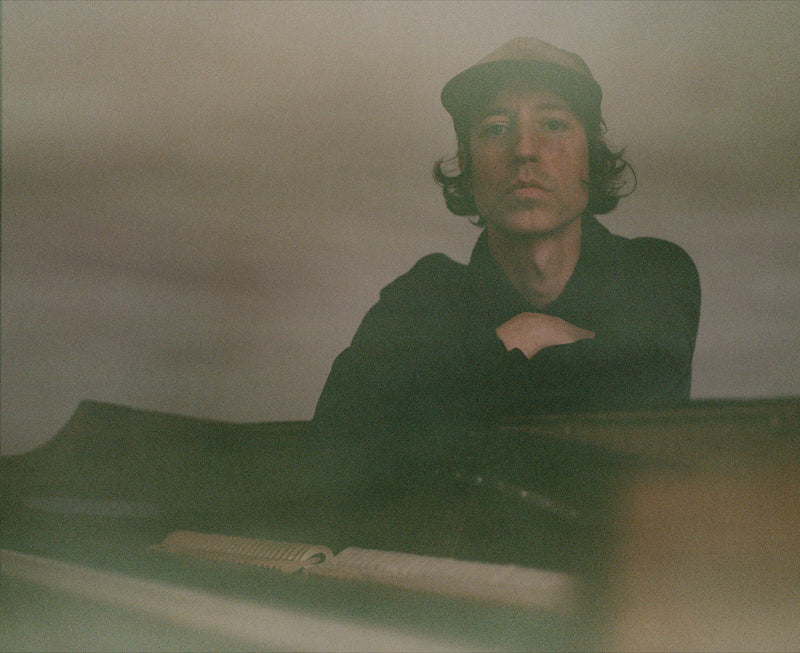
Josiah Steinbrick (b. 1981) is a composer, producer, and multi-instrumentalist originally from Providence, Rhode Island.

On moving to Los Angeles, he met then up-and-coming producer Danger Mouse (Brian Burton). Burton hired him as a session musician, and inadvertently offered a unique view of an auteur in his exploratory prime. Soon after, he met another important collaborator, Devendra Banhart, eventually joining his band. A shared love for left-field pop and “music that sounds like nothing is happening” (in tandem with becoming instrumentalist of choice for Banhart’s producer Noah Georgeson) resulted in Steinbrick contributing bass, drums, percussion, and synth arrangements to Devendra’s album Mala (2013). That same year, he also began working with Welsh artist Cate Le Bon, convincing her to come to Los Angeles to record her third album Mug Museum, which Steinbrick and Georgeson co-produced. Over the following years, Steinbrick produced another album by Banhart (2016’s Ape in Pink Marble) and two more by Le Bon (Crab Day, 2016, and the Mercury Prize-nominated Reward, 2019).

Steinbrick also formed the group Banana in 2014, with the Brazilian songwriter Rodrigo Amarante. Initially conceived as a way to play records in specific settings (its first event was as part of a three-week art series in an abandoned building) and with a performance element made up of members of Le Bon’s band, it developed almost accidentally into a forum for Steinbrick to explore his own compositional voice for the first time. A studio session was recorded for Dublab radio in Los Angeles and released by Leaving Records in 2017. That spirit continued in Steinbrick’s first solo release, Meeting of Waters (2017), a textural dream-suite consisting of “a lot of metal and wood” and a single synthesizer. In order to retain its impulse, he prepared little and worked almost spontaneously, capturing each layer in a single take. Produced by Le Bon, it was recorded in less than a week. His second solo record, Liquid/Devotion & Tongue Street Blue (2020) allowed elements of this process while exploring a wider range of bass, harmonic processing, and polyrhythm. Mouthfeel/Serene with Sam Gendel followed shortly after, comprised of reassembled 2018 improvisations inspired by Teo Macero’s editing techniques on Miles Davis’ Get Up with It and On the Corner.

Josiah Steinbrick Artist Page

About Sam Gendel

Sam Gendel

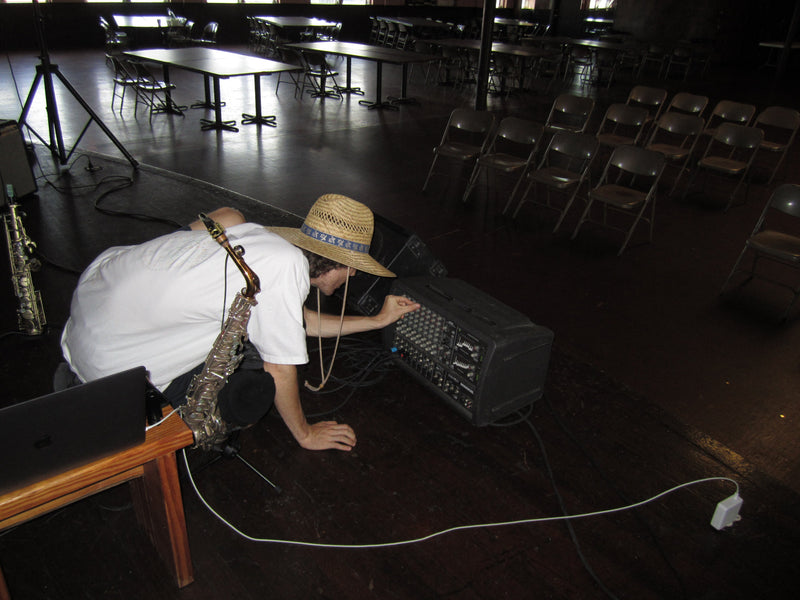
Sam Gendel is a musician and producer living in Los Angeles, California. He is most known for his work with the saxophone, though he is proficient on multiple instruments. His work is diverse and includes significant collaborations with a wide range of artists.

Sam Gendel Artist Page

Explore more Unseen Worlds releases