John McGuire - Double String Trios

John McGuire - Double String Trios

Compact Disc
$15.00
Skip to product information
John McGuire - Double String Trios

John McGuire - Double String Trios

$15.00
Format

Description

Double String Trios presents three major works for two string trios, composed by John McGuire between 2012 and 2021 and conducted by Axel Lindner. This release began with Walter Zimmermann asking Bernd Härpfer of Initiative Musik und Informatik Köln – GIMIK e.V. to arrange a concert premiere in celebration of McGuire’s 80th birthday.

McGuire’s musical roots lie in the electronic studios of postwar Cologne, shaped through studies with Karlheinz Stockhausen and Krzysztof Penderecki, and grounded in the traditions of European serialism. Working with synthesizers capable of generating up to 1,800 pulses per second, he developed a beautifully harmonious, crystalline music shaped by the ear into a world of flowing continuities between one point and the next.

Transferred to stringed instruments, that world becomes infinitely more complex — suffused with the richness and impurities of human players and their acoustic technologies. Conceived as two facing string trios in antiphonal dialogue, the music links studio spatial thinking with older split-ensemble traditions, unfolding through Fibonacci proportions, rotating tempi, shifting meters, and continual harmonic transposition.

Track List

CD TRACK LIST

  1. Jump Cuts (2009 - 2012) [21:46]
  2. Double Bars (2013 - 2016) [22:51]
  3. Playground (2016 - 2019) [18:02]

℗ 2026 Unseen Worlds, under license from GIMIK e.V.

© 2026 Unseen Worlds.

Credits

Trio 1:
Cristina Ardelean, Violin
Axel Porath, Viola
Adya Khanna Fontenla, Violoncello

Trio 2:
Lola Rubio, Violin (DOUBLE BARS, PLAYGROUND)
Karin Nakayama, Violin (JUMP CUTS)
Laura Hovestadt, Viola
Burkart Zeller, Violoncello

Conductor: Axel Lindner

Recording Location: Kunst-Station Sankt Peter Köln
Recording Date, DOUBLE BARS, PLAYGROUND: June 13th & 16th, 2023
Recording Date, JUMP CUTS: November 12th, 2024
Tonmeister/Recording: Hendrik Manook

Produced by Initiative Musik und Informatik Köln – GIMIK e.V.

Kindly supported by Kunststiftung NRW, Kulturamt der Stadt Köln and IFM e.V. – Initiative Freie Musik in Köln
Artistic directors: Bernd Härpfer and Siegfried Koepf

"Jump Cuts" premiered January 24, 2013, commissioned by the Ensemble Modern, Frankfurt

Special thanks: Walter Zimmermann, who requested Bernd Härpfer to arrange a concert premiere of "Double Bars" and "Playground" for John McGuire's 80th birthday; Michael Veltman for his hospitality at Kunst-Station Sankt Peter KölPackage Design: Joe Gilmore

Cover painting: "Perspective (Alberti)" by Crockett Johnson. Copyright © 1966 by Crockett Johnson. Used by permission of The Wylie Agency LLC. Digital image courtesy of the Division of Medicine and Science, National Museum of American History, Smithsonian Institution

Rehearsal photograph by Sonja Werner; Performance Photographs by Rick Minnich

Illustrations: John McGuire, Sketches for Three Double String Trios

Liner notes by Tim Rutherford Johnson

About John McGuire

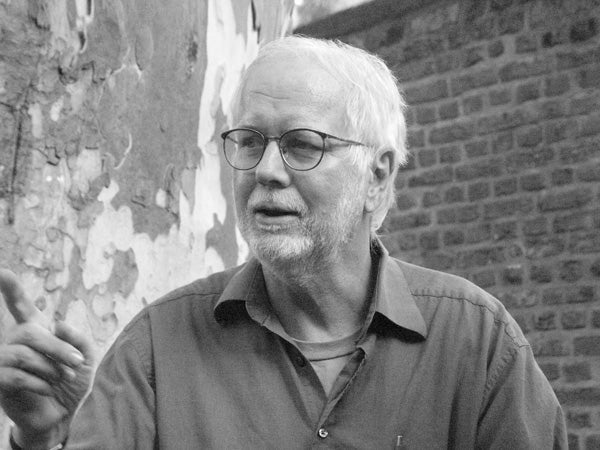
John McGuire (b. 1942) was born in Artesia, California. After completing his BA in music at Occidental College, Los Angeles (where he studied composition with Robert Gross), he received a series of travel scholarships that allowed him to study in Europe with Krzysztof Penderecki at the Folkwang Hochschule in Essen (1966–8) and with Stockhausen at Darmstadt (1967, 1968). After completing his MA at the University of California, Berkeley, in 1970, he returned to Europe, where he studied computer composition with Gottfried Michael Koenig at the Institute for Sonology in Utrecht, Netherlands (1970–71), before settling in Germany, where he remained until 1998. Between 1975 and 1977 he studied electronic music at the Hochschule für Musik (State Conservatory for Music) in Cologne, composing 108 Pulses, Pulse Music I and Pulse Music II during this time (in 1977 Pulse Music II was commissioned retrospectively by the composer and radio producer Hans Otte for his Pro Musica Nova festival at Radio Bremen). In 1978 Pulse Music III was the second of six commissions from Westdeutsche Rundfunk (the first was Frieze for four pianos, also commissioned retrospectively, in 1976) and was realized in the famous WDR electronic music studio in which Stockhausen had composed his first electronic works.

McGuire’s music, which combines influences from California and central Europe, is often described as a synthesis of serialism and minimalism, although this is an over-simplification. Certainly the role of Stockhausen in his musical development is undeniable, not only directly through his classes, but also indirectly through the friendships and associations McGuire made while he was living and working in Cologne: a crucial role was played by the Feedback Studio, a loose association of composers who had all either studied with Stockhausen or performed as part of his ensemble at the 1970 World’s Fair in Osaka. Yet although McGuire’s technique draws upon the parametrical and pulse-based thinking of Stockhausen’s work of the 1950s (and, to a lesser extent, anticipates much later pieces such as Cosmic Pulses of 2006–7), it applies that to a much more minimalist aesthetic based on processes of looping and layering, and simpler harmonic and rhythmic ratios. In this interview with Tim Rutherford-Johnson he describes his early career, and how he arrived at the musical style of 108 Pulses and Pulse Music I–III.

John McGuire Artist Page

Explore more Unseen Worlds releases