John McGuire - Double String Trios

John McGuire - Double String Trios

Compact Disc
$15.00
Skip to product information
John McGuire - Double String Trios

John McGuire - Double String Trios

$15.00
Format

Description

In his “Pulse Music” compositions of the mid-1970s, composer John McGuire forged a unique interpretation of European serialism. A student of Karlheinz Stockhausen, Krzysztof Penderecki and Gottfried Michael Koenig, McGuire moved to Cologne, Germany in 1970, where he become associated with the world-leading Studio for Electronic Music at Westdeutscher Rundfunk (WDR) in Cologne. Like Stockhausen, McGuire found his musical imagination both constrained and inspired by the technology that was available to him.

A conversation with sculptor Hans Karl Burgeff led McGuire to think beyond the horizon and into limitless space. For “Vanishing Points” (1985–1988), McGuire used an entirely digital set-up for the first time: a digital sequencer, eight Yamaha DX-7 synthesizers and a Studer 24-track digital tape recorder. The piece was conceived as a “sequel” to the Pulse Music series, but also a step forward from it. Whereas the Pulse Music pieces had employed steady streams of pulses, with Vanishing Points McGuire employed pulse layers that accelerate or decelerate against one another, vastly increasing the resulting rhythmic complexity.

McGuire's exploration of music technology continued in “A Cappella” (1990–1997), written for his wife, the soprano Beth Griffith, known for her recording of Morton Feldman’s “Three Voices” made in 1983. Using samples, he created a four-voice choir of voice samples and arranged them into interacting parts. The composition faced challenges due to the organic nature of the human voice compared to the precision of synthesized sounds. This process involved extensive editing and a negotiation between the "material" and the "original conception". This sort of negotiation applies as much to the composition of a single piece as it does to the work of two decades.

Track List

CD TRACK LIST

  1. Jump Cuts (2009 - 2012) [21:46]
  2. Double Bars (2013 - 2016) [22:51]
  3. Playground (2016 - 2019) [18:02]

℗ 2026 Unseen Worlds, under license from GIMIK e.V.

© 2026 Unseen Worlds.

Credits

Trio 1:
Cristina Ardelean, Violin
Axel Porath, Viola
Adya Khanna Fontenla, Violoncello

Trio 2:
Lola Rubio, Violin (DOUBLE BARS, PLAYGROUND)
Karin Nakayama, Violin (JUMP CUTS)
Laura Hovestadt, Viola
Burkart Zeller, Violoncello

Conductor: Axel Lindner

Recording Location: Kunst-Station Sankt Peter Köln
Recording Date, DOUBLE BARS, PLAYGROUND: June 13th & 16th, 2023
Recording Date, JUMP CUTS: November 12th, 2024
Tonmeister/Recording: Hendrik Manook

Produced by Initiative Musik und Informatik Köln – GIMIK e.V.

Kindly supported by Kunststiftung NRW, Kulturamt der Stadt Köln and IFM e.V. – Initiative Freie Musik in Köln
Artistic directors: Bernd Härpfer and Siegfried Koepf

"Jump Cuts" premiered January 24, 2013, commissioned by the Ensemble Modern, Frankfurt

Special thanks: Walter Zimmermann, who requested Bernd Härpfer to arrange a concert premiere of "Double Bars" and "Playground" for John McGuire's 80th birthday; Michael Veltman for his hospitality at Kunst-Station Sankt Peter KölPackage Design: Joe Gilmore

Cover painting: "Perspective (Alberti)" by Crockett Johnson. Copyright © 1966 by Crockett Johnson. Used by permission of The Wylie Agency LLC. Digital image courtesy of the Division of Medicine and Science, National Museum of American History, Smithsonian Institution

Rehearsal photograph by Sonja Werner; Performance Photographs by Rick Minnich

Illustrations: John McGuire, Sketches for Three Double String Trios

Liner notes by Tim Rutherford Johnson

About John McGuire

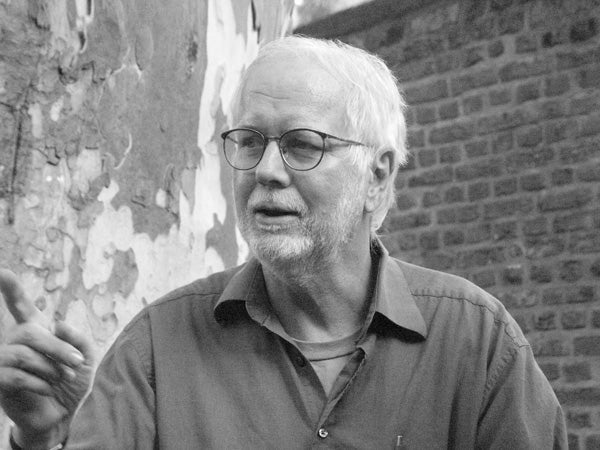
John McGuire

John McGuire (b. 1942) was born in Artesia, California. After completing his BA in music at Occidental College, Los Angeles (where he studied composition with Robert Gross), he received a series of travel scholarships that allowed him to study in Europe with Krzysztof Penderecki at the Folkwang Hochschule in Essen (1966–8) and with Stockhausen at Darmstadt (1967, 1968). After completing his MA at the University of California, Berkeley, in 1970, he returned to Europe, where he studied computer composition with Gottfried Michael Koenig at the Institute for Sonology in Utrecht, Netherlands (1970–71), before settling in Germany, where he remained until 1998. Between 1975 and 1977 he studied electronic music at the Hochschule für Musik (State Conservatory for Music) in Cologne, composing 108 Pulses, Pulse Music I and Pulse Music II during this time (in 1977 Pulse Music II was commissioned retrospectively by the composer and radio producer Hans Otte for his Pro Musica Nova festival at Radio Bremen). In 1978 Pulse Music III was the second of six commissions from Westdeutsche Rundfunk (the first was Frieze for four pianos, also commissioned retrospectively, in 1976) and was realized in the famous WDR electronic music studio in which Stockhausen had composed his first electronic works.

McGuire’s music, which combines influences from California and central Europe, is often described as a synthesis of serialism and minimalism, although this is an over-simplification. Certainly the role of Stockhausen in his musical development is undeniable, not only directly through his classes, but also indirectly through the friendships and associations McGuire made while he was living and working in Cologne: a crucial role was played by the Feedback Studio, a loose association of composers who had all either studied with Stockhausen or performed as part of his ensemble at the 1970 World’s Fair in Osaka. Yet although McGuire’s technique draws upon the parametrical and pulse-based thinking of Stockhausen’s work of the 1950s (and, to a lesser extent, anticipates much later pieces such as Cosmic Pulses of 2006–7), it applies that to a much more minimalist aesthetic based on processes of looping and layering, and simpler harmonic and rhythmic ratios. In this interview with Tim Rutherford-Johnson he describes his early career, and how he arrived at the musical style of 108 Pulses and Pulse Music I–III.

You may also like