Philip Corner - EXTREEMIZMS early & late

Philip Corner - EXTREEMIZMS early & late

CD
$10.00
Skip to product information
Philip Corner - EXTREEMIZMS early & late

Philip Corner - EXTREEMIZMS early & late

$10.00
Format

Description

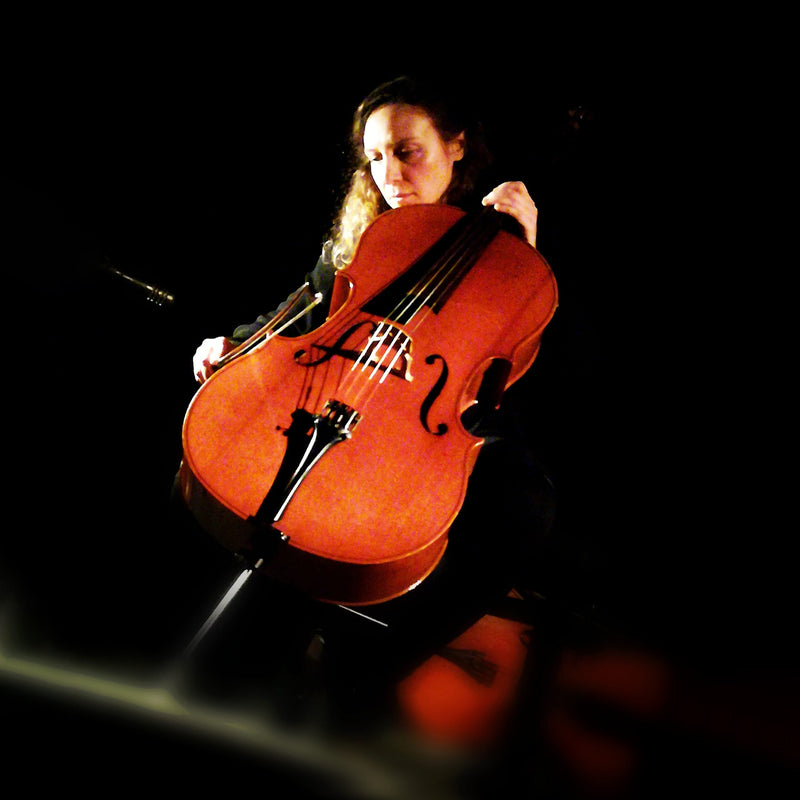
Extremes are extreme, extremely. For Philip Corner, a lifelong commitment to extremes - extreme expression, extreme beauty, extreme noise, extreme silence - developed a mastery of expression, any one extreme may result in all of the others. In gripping new recordings by the duo of Silvia Tarozzi, violin, and Deborah Walker, cello - with assistance from Rhodri Davies, harp, and Philip Corner, piano - Corner's early ensemble works from 1958 are paired with newer, late works from 2015-2016. The works from 1958, "Two-part monologue" and "FINALE,” were composed while Corner was teaching at City College and still finishing his Masters at Columbia University under Henry Cowell and Otto Luening. Extremes being extreme, they were too extreme for Columbia. Yet, Corner completed his degree and continued to stretch on, creating works somewhere between the supercomputer-refined micro-tunings of James Tenney and the ecstatic enactments of Malcolm Goldstein, his Tone Roads bandmates. Now, with the world (somewhat) caught up, we can appreciate Philip Corner’s EXTREEMIZMS, early and late, together.

Track List

CD TRACK LIST

  1. wHoly Trinitye, a duality ov duos - first (2016)      
  2. 2 Extreemizms (2015)
  3. Two-part Monologue No. 1 (1958) 
  4. Two-part Monologue No. 2 (1958)*
  5. Two-part monologue No. 3 (1958) 
  6. wHoly Trinitye, a duality ov duos - second (2016)
  7. FINALE - violin, cello, piano (1958)*
  8. wHoly Trinitye, for a “free-togethering” (2016)^
  9. wHoly Trinitye, another Duet, just-one (2016)

Silvia Tarozzi (violin), Deborah Walker (cello)
*w/ Philip Corner (piano)
^w/ Rhodri Davies (harp) 

Credits

Recorded by Roberto Salvati, December 2016 at Angelica Centro di Ricerca Musicale - Teatro San Leonardo (Bologna, IT) except track 8 recorded live by Andrea Rovacchi, Mai 2016 at Palazzo Magnani (Reggio Emilia, IT)
Mixed by Roberto Salvati, September 2017 at Angelica Centro di Ricerca Musicale except tracks 3, 4, 9 mixed by Andrea Rovacchi, February 2018 at Sound Temple Studio (Parma, IT)
Mastered by Andrea Rovacchi, February 2018 at Sound Temple Studio

Design Philip Corner

About Philip Corner

(April 10, 1933 - )

After The High School of Music & Art in New York City, Philip Corner received his BA (1955) at CCNY, where his most important teacher was Fritz Jahoda; and an MA (1959) from Columbia University where his composition teachers were Otto Luening and Henry Cowell, The two years in between (1955–57) were spent in Paris at the Conservatoire Nat'l de Musique, following the class "Philosophie Musicale" of Olivier Messiaen. Equally important was his friendship with the Canadian painter Paul-Emile Borduas, who introduced him to "la grande aventure nord-américaine", to which he returned and became part of the group around John Cage. At the same time he resumed his studies of the piano with Dorothy Taubman, which was to have a significant role in his compositional as well as performing life.

He taught Modern Music at the New School for Social Research from 1967–1970, inheriting the class founded by John Cage at double remove after Richard Maxfield, with whom he was teaching assistant, and Malcolm Goldstein. His teaching career started at a New York City high school and continued at the New Lincoln School where he helped develop the music department and introduced innovative courses (1966–1972). During this period he was married to the astrologer and trance medium Julie Winter who was also a minister in the Church of Religious Science, with which he too was associated, composing music to be sung at meditation sessions. From 1972 to 1992 he continued as professor at the newly established Livingston College, a part of Rutgers, the State University of New Jersey, soon to be absorbed into the Mason Gross School of the Arts. He then took early retirement and moved to Reggio Emilia, Italy where he had previous contact through the Pari e Dispari "Arte Club Internazionale". An early friend, the dancer and choreographer Phoebe Neville, joined him there and became his wife and performance partner.

He was a founding participant of Fluxus since 1961, was a resident composer and musician with the Judson Dance Theatre from 1962 to 1964 and later with the Experimental Intermedia Foundation upon the invitation of Elaine Summers, for whose dance company he served as musician. He co-founded with Malcolm Goldstein and James Tenney the Tone Roads Chamber Ensemble in 1963 (active until 1970), with Julie Winter Sounds Out of Silent Spaces in 1972 (active until 1979) and with Barbara Benary and Daniel Goode, Gamelan Son of Lion in 1976 (still active).

Philip Corner Artist Page

About Silvia Tarozzi

Silvia Tarozzi is a violinist, composer and improviser. The oral transmission of music and the form created through a deep immersion into the sound are traits of her musical research. She has been in a duo with Italian cellist Deborah Walker for about 15 years, and has been the violinist of the French ensemble Dedalus since 2006. She has closely collaborated with and performed work by composers such as Éliane Radigue, Pauline Oliveros, Pascale Criton, Cassandra Miller, Martin Arnold, Pierre-Yves Macé, Philip Corner.

Silvia started composing and improvising at the same time, starting from her experience as an interpreter and through a process of opening up to more creative musical approaches. In 2009 she began to write songs inspired by Italian poetress Alda Merini which became the album Mi specchio e rifletto.

She has been working with the French composer Pascale Criton since 2010 on the technical and expressive possibilities of a violin tuned in sixteenths of tone. From this research comes Circle Process for microtonal violin, which was presented at numerous international festivals. Since 2011 Silvia has also regularly collaborated with Éliane Radigue, becoming one of the main interpreters of her compositional cycle Occam Océan for acoustic instruments and creating numerous works ranging from the violin solo Occam II to chamber music, performing with many of Éliane’s interpreters.

Since 2011, Silvia has also coordinated, with Giovanna Giovannini, the activities of the children choir Piccolo Coro Angelico. This project focuses on vocal research and experimentation, bringing children to an open and creative approach to music since the beginning of their musical experience. We conceive that art is a inclusive concept that depends only minimally on technical competence and which instead helps children to develop their skills and talents.

Silvia Tarozzi Artist Page

About Deborah Walker

Italian cellist Deborah Walker is a new music performer and improviser based in Berlin. She is interested in multiple forms of music creation related to the exploration of sound and interaction with other art forms.

She has played at many festivals such as Tectonics, Italia Wave, ZKM, Centre Pompidou, and tours regularly in International venues and Festivals. She is a member of the French ensemble Dedalus and of the improviser orchestra ONCEIM. She has premiered solo works of composers like Pascale Criton, Éliane Radigue, Philip Corner and Phill Niblock. For more than 15 years, she has perfored regularly in duo with violinist Silvia Tarozzi. Their repertoire includes both contemporary and experimental works, as well as transcriptions of Italian traditional folk songs.

After receiving a Masters in Music and sound composition at the University of Paris 8, Deborah completed a PhD at the University of Lorraine on the work of Fluxus artists in Italy, with a focus on the American cellist Charlotte Moorman.

She released her first solo album, Starflux, in 2020 on the Elli Records label out of France.

Deborah Walker Artist Page

Explore more Unseen Worlds releases